Start your day with intelligence. Get The OODA Daily Pulse.

Informing your decisions with actionable intelligence
Start your day with intelligence. Get The OODA Daily Pulse.
Informing your decisions with actionable intelligence
Evaluating a company’s AI capabilities from the outside is hard. If it is a cooperative engagement where a firm is undergoing due diligence it is a bit easier, since management will cooperate and provide responses to questions. But if it is a competitive assessment it requires extensive research, analytical rigor and hard work by professionals with experience in enterprise IT. Even then the results have to be caveated with disclaimers about the lack of comprehensive information.
But now thanks to AI and the interoperable standards for creating Agent Skills in use by all major platforms, anyone can use the same professional methodologies we use at OODA to kickstart due diligence on company use of AI. This post describes how and points to a skill you can use to empower your AI to help you do repeatable standard assessments on how a firm stands in preparation for the new world of AI.
Our methodology for assessing organizational use of AI is called the AI Acceleration Quotient or AAQ.
More info including how to find the skill for you own use it below.
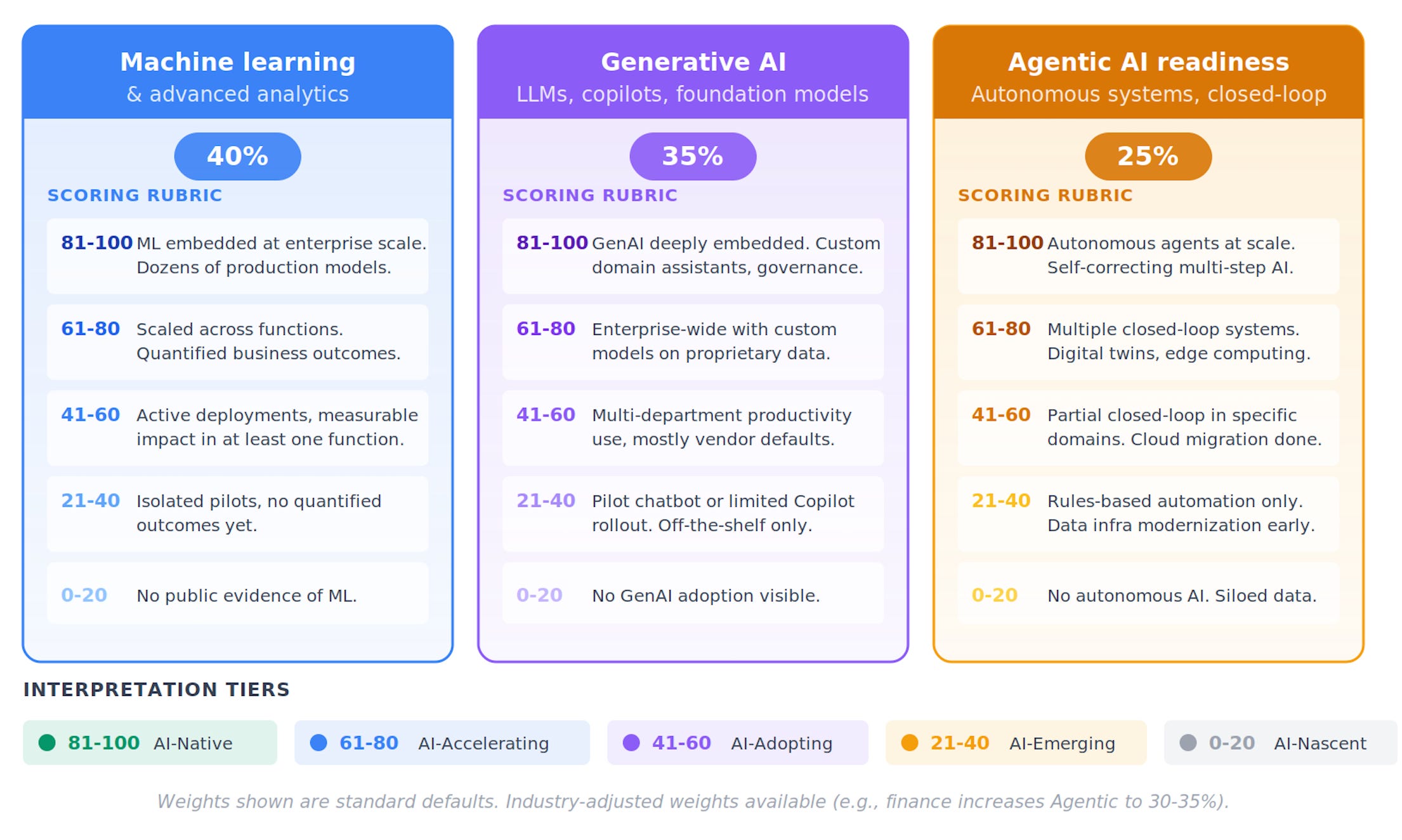
The AI Acceleration Quotient (AAQ) is a composite scoring methodology that measures an organization’s AI maturity on a 0–100 scale. It breaks that score into three weighted dimensions, each representing a distinct wave of AI capability that organizations must navigate.
Machine learning maturity asks whether the organization is running production ML models that influence real business decisions. Not proofs of concept. Not internal experiments. Deployed systems with data infrastructure behind them, MLOps practices in place, and measurable business outcomes. Companies still in pilot mode score low here, not because they’ve done nothing, but because the work hasn’t compounded yet.
Generative AI adoption goes beyond whether someone in the company has an OpenAI account. This dimension looks at how deeply generative AI is integrated into workflows, whether the organization is building on foundation models or merely consuming APIs, and critically, how it handles the governance and risk challenges that come with deploying generative systems at scale. Experimentation is the floor, not the ceiling.
Agentic AI readiness is the frontier dimension. Agentic systems don’t just respond to prompts, they take actions, orchestrate other systems, and operate autonomously across extended tasks. This dimension assesses whether the technical architecture can support autonomous agents, whether the organization has the governance frameworks to deploy them responsibly, and whether there’s genuine institutional willingness to delegate consequential decisions to AI.
Each dimension is scored against a structured rubric. The three scores combine into a single composite AAQ using standard or industry-adjusted weights. A score at 80+ reflects a genuine AI-native organization. A score at 30 or below reflects an organization still treating AI as a departmental experiment.
True due diligence is a very human-intensive process. When OODA is engaged for this sort of assessment it always involves deep research, multiple in-person meetings, interviews, phonecalls, video calls, reviews of information disclosed by the parties for use in the diligence work. And this work is done by experienced professionals who know the industry and enterprise IT and the market. Of course part of the research involves open sources of information, but that is just one component.
The human intensive process is required for serious work. But now in the age of AI this serious work can be kickstarted by adding some of OODA’s methods to AI tooling. You can use these methods over internet accessible information for any company or industry and generate insights for free.
The AAQ is now packaged as a portable AI Agent skill. This skill is a structured set of instructions and workflows that can be loaded into any major AI system and executed against any target organization or market sector.
The technology behind it is simple. The skill uses the combination of large-scale internet knowledge, including everything an advanced AI model absorbed during training and also live searches of all public info. Public info targeted includes SEC filings, press releases, industry use cases, new, public presentations from leaders, job descriptions and any other source available on the net. The skill retrieves, then reasons across sources, reconciles conflicting signals, and applies the scoring rubric the same way every time.
What steers all of this is the methodology itself. The rubric, the weighting logic, the evidence standards, the output templates, that’s the human knowledge encoded in the skill. The AI provides the scale and the research horsepower. The methodology provides the judgment framework.
The skill runs on the major AI platforms:
The output is consistent regardless of which platform runs it. That’s the point. The skill is the methodology, not the model.
To show what this looks like in practice, I just ran the AAQ across a set of major companies in the airlines industry.
After the skill is loaded all I had to do was tell my AI “Run an AAQ on the top global airlines” Then it asked me a few questions:
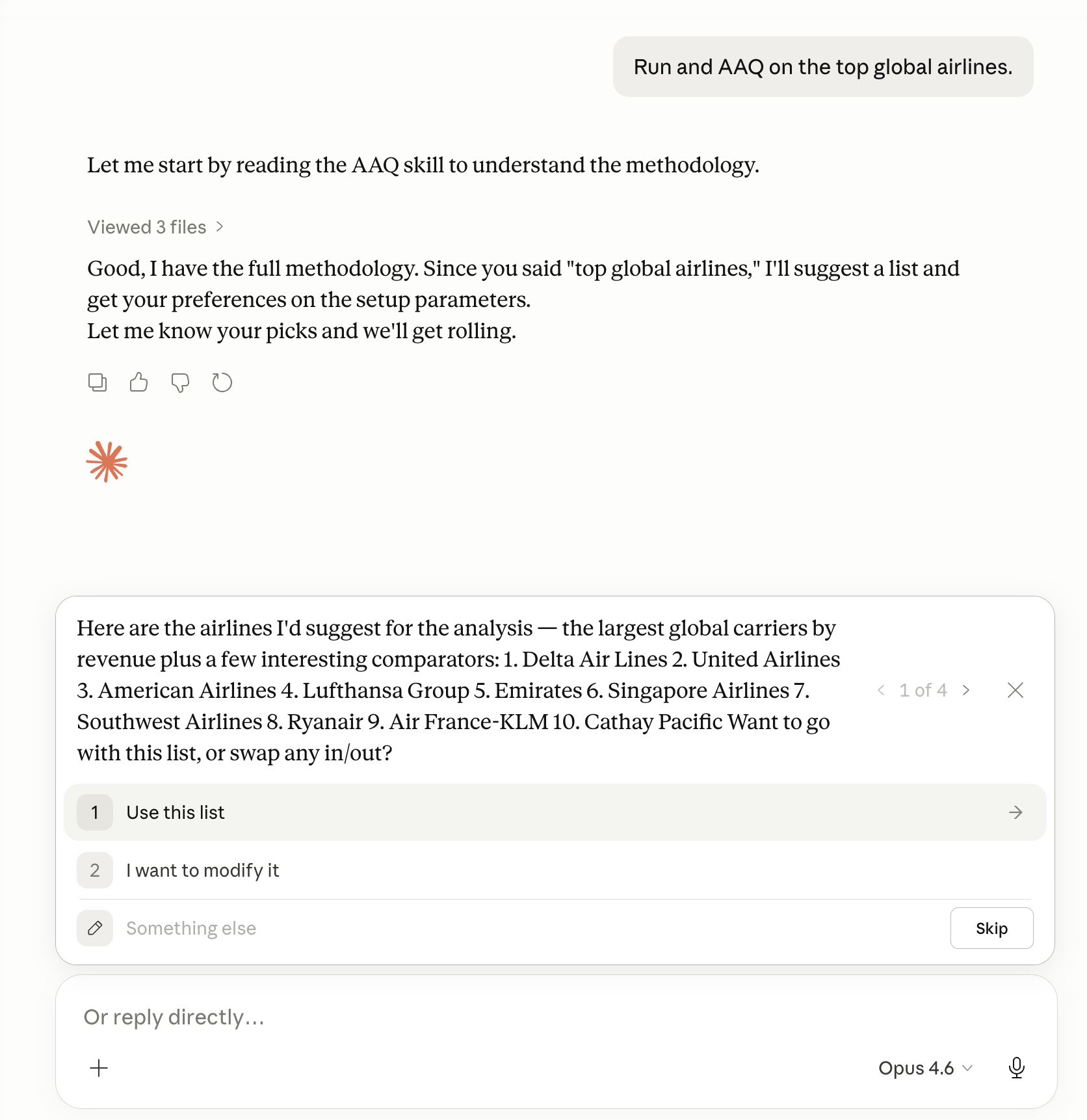
I told it to use the list. It then asked if I wanted output in a word doc or powerpoint or chat. I told it give it to me in each. The word document included charts, tables, graphics and detailed overviews of each airline and the overall industry. I would compare this free report to paid reports costing thousands of dollars from commercial research firms. It is really that good.
The powerpoint was full of great graphics suitable for executive level discussions:
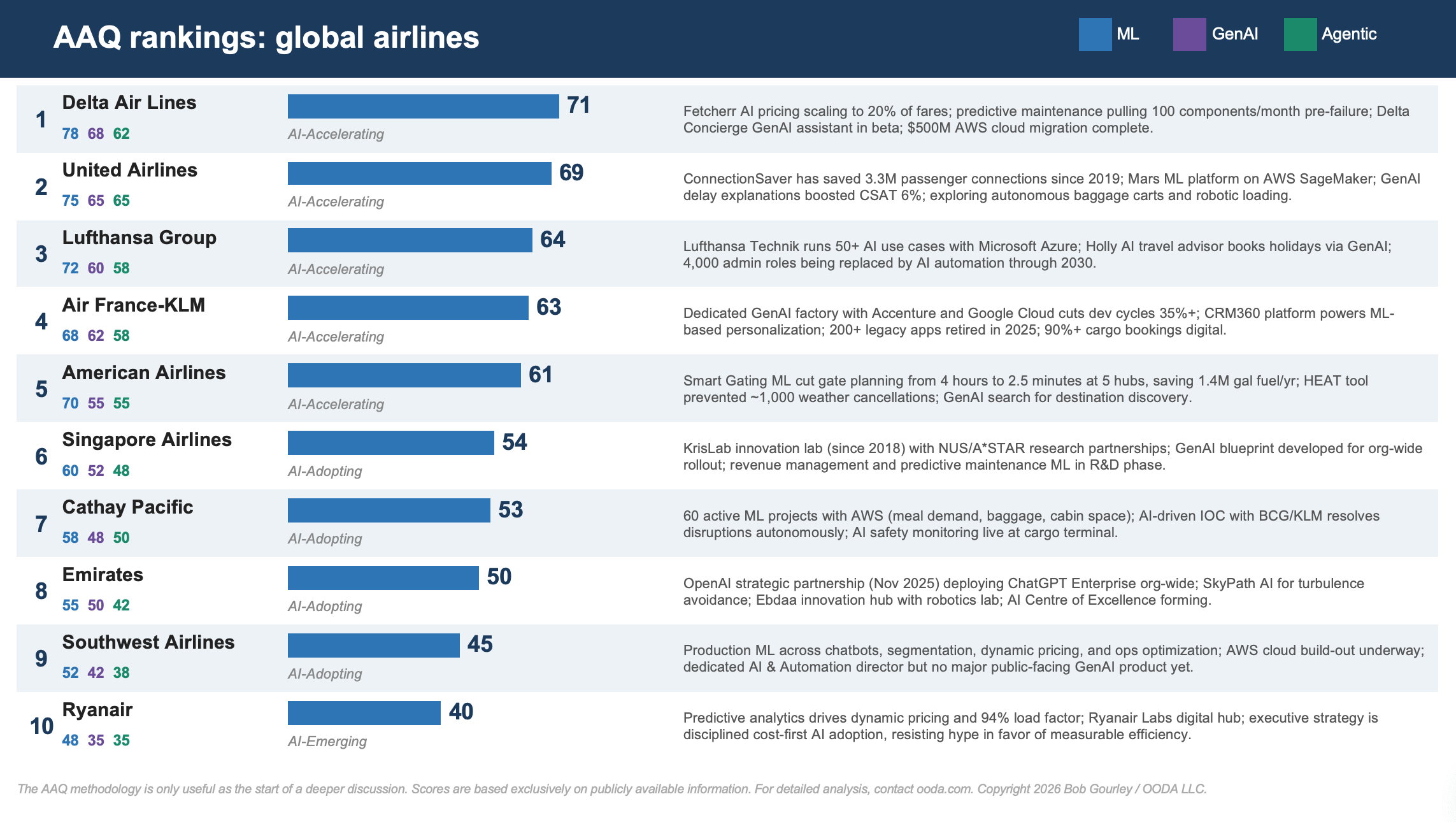
The details in the word doc go far further. It is really amazing what open source intelligence and a great methodology can deliver.
If you want to run an AAQ assessment yourself, the skill and full documentation are available at the AI Acceleration Quotient or AAQ and Using the AI Acceleration Quotient.
Load it into your AI system of choice, point it at a target organization or a market sector, and follow the workflow. The rubric handles the rest.
For organizations that want scored assessments with full sourcing, competitive benchmarking across a sector, or integration into M&A or investment due diligence, reach out directly through OODA.
The methodology is open. The work is still valuable. Those two things are not in conflict.
“AI Acceleration Quotient” and “AAQ” are trademarks of OODA LLC. Copyright 2026 OODA LLC. Licensed under CC BY-NC-ND 4.0.

About the Author
Bob Gourley is an experienced Chief Technology Officer (CTO), Board Qualified Technical Executive (QTE), author and entrepreneur with extensive past performance in enterprise IT, corporate cybersecurity and data analytics. CTO of OODA LLC, a unique team of international experts which provide board advisory and cybersecurity consulting services. OODA publishes OODALoop.com. Bob has been an advisor to dozens of successful high tech startups and has conducted enterprise cybersecurity assessments for businesses in multiple sectors of the economy. He was a career Naval Intelligence Officer and is the former CTO of the Defense Intelligence Agency.
Informing your decisions with actionable intelligence
Informing your decisions with actionable intelligence