Editor’s note: This overview of the Munich area defense, aerospace and deep tech community by OODA network expert Florian Wolf provides an insightful introduction useful to understanding the incredible tech ecosystem in this region. The focus on defense, aerospace and deep tech (including quantum) tells a big part of the story, but there is far more going on there, too much to cover in one post, including key centers of engineering excellence in biotech and pharma. -bg
Part I: Why Munich
Germany’s Aerospace & Defense Heartland
BMW, probably Munich’s best-known company, started out as an aircraft engine designer and manufacturer in WWI (and even to this day, the fighter-pilot spirit lives on in some BMW drivers).
Bavaria is among Germany’s largest aerospace and defense locations, centered on the Munich area: roughly 550 aerospace companies generating about €12-13B in annual revenue and employing on the order of 40,000-60,000 people (depending on which sub-sectors are counted).
Globally connected. Munich Airport is Lufthansa’s second-largest hub and a major Star Alliance gateway, with nonstop service to the places that matter most for this ecosystem: multiple daily flights to major US cities, plus direct links to Tel Aviv and the UAE. This keeps talent, customers, and investors just a direct flight away.
Airbus Defence and Space is headquartered in the Munich area (Taufkirchen/Ottobrunn).
Major postwar programs with Bavarian roots include:
F-104 Starfighter: US (Lockheed) design license-built in Germany with Bavarian industry (Messerschmitt, Augsburg).
Tornado: multinational strike jet; German share assembled at Manching, Bavaria.
Eurofighter Typhoon: German final assembly at Manching by Airbus Defence and Space.
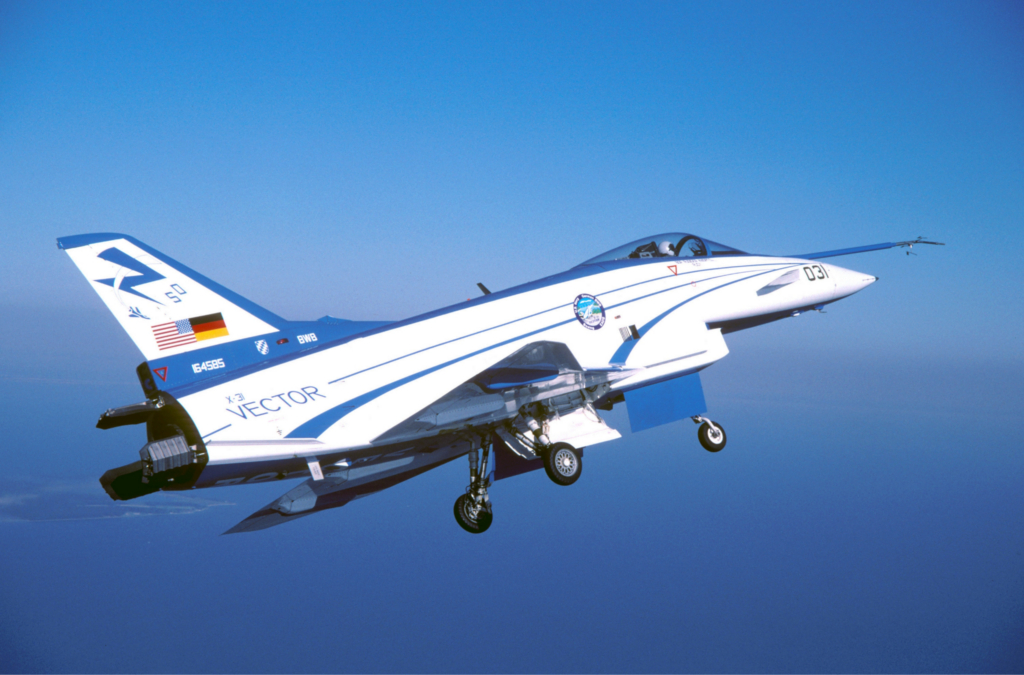
X-31: US-German experimental jet (Rockwell + MBB) that pioneered thrust-vectoring post-stall maneuvers. The surviving aircraft is displayed at the Deutsches Museum’s Flugwerft Schleißheim near Munich.
Bo 105: the world’s first light twin-engine helicopter, developed by MBB at Ottobrunn; the PAH-1 anti-tank version served the German Army.
Tiger / NH90 helicopters: built by Airbus Helicopters in Donauwörth, Bavaria.
Leopard 2: main battle tank developed and built by Krauss-Maffei in Munich (now KNDS Deutschland).
Taurus KEPD 350: air-launched cruise missile built by Taurus Systems (MBDA Deutschland + Saab) in Schrobenhausen, Bavaria.
MEADS: US-German-Italian air-and-missile-defense program (Lockheed Martin with MBDA Deutschland, Schrobenhausen); became the basis for Germany’s planned TLVS.
Oberpfaffenhofen, just west of Munich, hosts DLR’s German Space Operations Center (GSOC), which runs the ISS Columbus module control center and operates numerous Earth-observation and government satellite missions. It is also a site of OHB System, which built Germany’s military radar-reconnaissance satellites (SAR-Lupe and its successor SARah) for the Bundeswehr.
The Long Quiet, and the Revival
For roughly three decades after the Cold War, German aerospace and defense were comparatively dormant. The post-1990 “peace dividend” cut defense spending from about 2.5% of GDP in 1990 to between 1.1% and 1.4% from 2005 to 2022. Relative to 1980s levels, Germany is estimated to have underspent by around €394B over three decades. The industry consolidated, few major new combat programs followed the Eurofighter, and German space activity stayed largely institutional rather than commercial.
Two forces reversed this:
Zeitenwende (2022): Three days after Russia invaded Ukraine, Germany announced a €100B special fund for the Bundeswehr and committed to defense spending above 2% of GDP. Spending has since grown at an unprecedented pace.
NewSpace and dual-use startups: A wave of Munich-area companies was founded around 2018-2023 (Isar Aerospace, RFA, Quantum Systems, Helsing, ARX Robotics, and others), drawing US and NATO venture capital and engineering talent from a struggling automotive sector.
Germany’s automotive industry is in a structural crisis, not just a cyclical dip: the late, costly pivot to EVs, intense Chinese competition, and overcapacity have triggered sustained layoffs and restructuring across manufacturers and suppliers.
Just as important is a shift in how engineers see the sector. Increasingly, the strongest talent views automotive as conservative and slow-moving, no longer the place where the most exciting engineering happens. As a consequence, they are drawn instead to defense, aerospace, and space, where Munich’s startups in particular are hiring.
A Research Base Tilting Toward Defense
Technical University München (TUM) has broken with the “civil clause” (Zivilklausel) that commits many German universities to civilian-only research. The only comparable case so far is Karlsruhe Institute of Technology (KIT), which grew out of Germany’s national nuclear research center (Kernforschungszentrum Karlsruhe, 1956) and still conducts nuclear research today.
Garching (a research suburb just north of Munich) anchors the region’s basic-science base, several institutes feeding directly into local deep-tech startups:
Max Planck Institute for Plasma Physics: fusion research; the startup Proxima Fusion spun out of it (profiled in Part VI).
Max Planck Institute of Quantum Optics: a feeder to the Munich quantum-computing scene.
The “Atom-Ei” (Atomic Egg): Germany’s first nuclear reactor (the original FRM, critical in 1957), acquired under the US “Atoms for Peace” program. Its egg-shaped dome became a landmark, it seeded the Garching research campus, ran until 2000, and is now a protected building.
FRM II research reactor (operated by TUM, opened 2004): a high-flux neutron source fueled with highly enriched uranium (~93% U-235, the weapons-grade enrichment level), long a dual-use and proliferation concern. It has been shut down since March 2019, with restart held up by the delayed replacement of its central channel, the core aluminum tube that holds the reactor’s fuel element. Conversion to low-enriched fuel is not expected before the early 2030s.
European Southern Observatory (ESO): its headquarters are in Garching, though its telescopes are mostly in Chile’s Atacama Desert.
Locals sometimes jokingly call Garching “Novogarchinsk,” a nod to its functional, vaguely Eastern-Bloc building stock and its distinctly un-Mediterranean charm in the winter months.
The Distributed Manufacturing Base
A lot of Germany’s defense manufacturing base is highly distributed and deliberately low-profile.
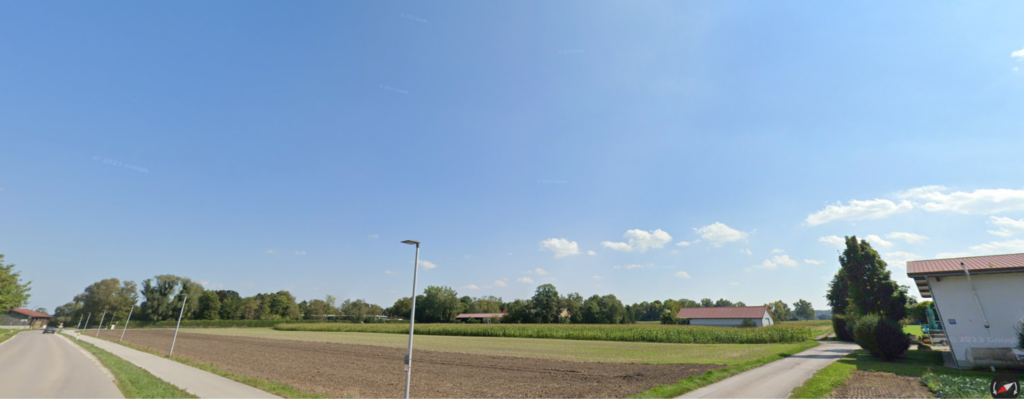
For example, the Google Maps screenshot below shows a location about 5 minutes from where I live. One of the buildings is part of a farm store where I buy my fruits, fish, and vegetables. Another one is a highly specialized manufacturing company that makes metal parts for aerospace and defense applications. This setup, using nondescript barns, is relatively common and intentional around here.
The Flip Side: The Region Is Becoming A Target
As Germany’s leading defense hub, the Munich region is a standing target for Russian hybrid activity: espionage, sabotage planning, cyber intrusions, and surveillance of military and industrial sites. This imposes a real counterintelligence and security burden on companies operating here, part of why the manufacturing base often stays deliberately low-profile.
If you’re 40 and you finally start doing your own laundry instead of letting your mom do it, you’re not turning your back on your family. You’re still part of it. If anything, the family gets stronger.
German defense sovereignty has the same intent: it isn’t about separating from allies, it’s about growing up within the alliance.
Transatlantic, Not “European-Only”
One indicator of transatlantic orientation is how Munich’s defense startups are often built and funded.
US capital: Helsing raised from US VCs General Catalyst, Lightspeed, and Accel (plus BDT & MSD Partners); Quantum Systems is backed by Peter Thiel. NATO Innovation Fund money recurs across the ecosystem (ARX Robotics, Tytan, Isar Aerospace).
US operations: Quantum Systems runs a US entity, Quantum-Systems Inc., with manufacturing in Moorpark, California, opening a 135,000 sq ft production facility there in June 2025 to serve North American defense customers.
This is a notably different instinct from France’s model of “European strategic autonomy,” which favors a more self-contained European bloc, led from Paris. Germany’s defense-tech companies are instead weaving themselves into US capital and, increasingly, US supply chains. For US partners, the signal is integration, not autonomy.
US-German defense collaboration has deep roots: the X-31 (Rockwell + MBB), a 1990s thrust-vectoring demonstrator. Today’s transatlantic link runs less through joint government programs and more through capital and commercial ties.
Part III: The Ukraine Connection
Ukraine’s combat-tested defense-tech ecosystem is increasingly wired into Munich and Germany more broadly:
Brave Germany (May 2026): a joint Ukrainian–German defense-tech program, signed by the two countries’ defense ministers and implemented in partnership with Ukraine’s Brave1 innovation cluster, with a grant mechanism for startups in unmanned systems, AI, and high-power lasers.
Brave1 Invest Demo Day was held in Munich (October 2025), connecting Ukrainian defense-tech startups with investors.
Several leading startups have real operations in Ukraine. Tytan Technologies has production facilities in Ukraine and supplies thousands of interceptor drones to Ukrainian forces, scaling manufacturing across both Germany and Ukraine. Helsing has operated in Ukraine since 2022 and produces thousands of strike drones (HF-1, HX-2) together with Ukrainian industry.
What they do: AI software for defense (drone autonomy, electronic warfare, sensor fusion, real-time battlefield data), and increasingly its own hardware (e.g., HX-2 strike drones).
Recent moves: Its Centaur AI flew a Saab Gripen E in beyond-visual-range tests in 2025 (AI in control of a real fighter); it unveiled the CA-1 Europa, an autonomous AI fighter jet (3-5 ton class); and it acquired Bavaria-based Grob Aircraft (a carbon-composite and military-trainer specialist) to build the airframes.
Investors: Prima Materia (Daniel Ek), General Catalyst, Lightspeed, Accel, Plural, Greenoaks, Saab (strategic), BDT & MSD Partners.
Funding: €600M Series D (June 2025) at a ~€12B valuation. As of mid-2026, reported to be raising ~$1.2B at an ~$18B valuation (led by Dragoneer and Lightspeed), which would make it Germany’s most valuable startup; not yet confirmed closed.
What they do: AI-powered fixed-wing/VTOL unmanned aerial systems for defense, security, and commercial use. HQ Gilching, Bavaria.
Investors: Balderton Capital, Peter Thiel, Porsche SE, Hensoldt (strategic), Airbus Defence and Space (strategic), Bullhound Capital; EIB financing (2026).
Funding: €160M Series C (May 2025, reached unicorn status) + €180M extension (late 2025), for ~€340M raised in 2025; valuation ~€3B.
What they do: AI-powered unmanned ground vehicles (UGVs) and “Mithra OS,” an AI operating system to retrofit legacy vehicles for autonomy. Founded 2022 by ex-Bundeswehr officers. HQ Munich.
Investors: HV Capital (led Series A), Omnes Capital, NATO Innovation Fund, Project A, Speedinvest (led extension), Heliad.
Funding: €31M Series A (April 2025) + €11M extension (July 2025) = €42M total.
What they do: Air-to-air counter-drone defense system (flagship “Sentinel”), billed as the world’s first air-to-air counter-drone system. Founded 2023, Munich.
Investors: IQ Capital (led seed), HTGF, Expeditions Fund, Sentris Capital, General Catalyst, HCVC (led pre-seed).
What they do: Developing the “Spectrum” two-stage orbital launch vehicle (~1,000 kg to LEO). HQ Ottobrunn, near Munich.
Notable: Its in-house Aquila engines run on propane and liquid oxygen, an unusual fuel chosen for high density-specific impulse and cleaner burning. Spectrum’s March 2025 flight was the first orbital launch attempt from continental Europe by a private company.
Investors: Molten Ventures, Island Green Capital (Series D), plus Porsche SE, NATO Innovation Fund, HV Capital, Lakestar, Earlybird, UVC Partners, Bayern Kapital.
Funding: €270M Series D (June 2026); ~€800M raised total including a €150M convertible bond (2025).
Launch status: Has not yet reached orbit. The first Spectrum flight (March 30, 2025) failed ~30 seconds after liftoff; subsequent 2026 attempts were scrubbed or aborted.
What they do: Developing the RFA ONE small/medium launch vehicle for satellite launch services. Has not yet launched.
Notable: Its Helix engine is Europe’s first staged-combustion-cycle rocket engine (kerosene/LOX). RFA says the cycle’s ~7% efficiency gain translates into roughly 30% more payload than the simpler engines used by most new-space rivals.
Investors: Majority-owned by OHB SE; KKR (€30M, 2023); DLR grants; UK Space Agency.
Funding: ~$47M grant (Nov 2024). Total private funding varies widely across sources and is not reliably confirmed.
What they do: Developing “Nyx,” Europe’s first reusable cargo space capsule (~3,000 kg), including ISS resupply. Dual HQ Munich / Bordeaux.
Investors: Balderton Capital + Plural (co-led Series B), Bessemer, NGP Capital, French Tech Souveraineté, DeepTech & Climate Fonds, EQT Ventures, Red River West, Cherry Ventures, Promus Ventures, Bayern Kapital.
Funding: $160M Series B (November 2024).
Note: “Mission Possible” demonstrator (June 2025) achieved reentry milestones but lost contact before splashdown, a “partial success.” Nyx maiden flight targeted ~2028.
What they do: Deployable mechanisms, actuators, antennas, and solar arrays for spacecraft; pioneering in-space manufacturing (3D-printing solar arrays in orbit). HQ Germering, Bavaria.
Investors: Expansion + BayBG (co-led Series A), HTGF, Aurelia Foundry, Ventis, Rymdkapital, Decisive Point Europe; €9.5M European Innovation Council grant.
Funding: €4.4M Series A (equity) + €9.5M EIC grant (non-equity).
What they do: Space-based data and analytics via a large LEO nanosatellite constellation (weather, maritime/AIS, aviation/ADS-B, RF detection).
Why it is listed here: A US-listed company (NYSE: SPIR, HQ in Vienna, Virginia) included as an example of foreign space/defense firms establishing their European presence in Munich: Spire opened a Munich-area office and manufacturing plant (Taufkirchen) through its German subsidiary, serving German customers including the Bundeswehr.
Funding: ~$248M raised historically (around its 2021 SPAC listing); FY2025 revenue ~$72M. Now funded via public markets and government contracts.
The areas below are included because each is adjacent to defense, not because they are defense companies as such. For example:
Nuclear fusion is dual-use (laser inertial-confinement fusion shares physics with thermonuclear-weapons science; fusion also bears on energy security).
Critical minerals are a core defense supply-chain dependency (rare-earth magnets in missiles, aircraft, and drones)
Quantum is dual-use across cryptography, sensing, and computing.
Nuclear Fusion
Note: Commercial fusion power remains unproven. No plant has yet produced net electricity, and timelines have historically slipped, hence the long-standing “always 30 years away” skepticism. Both companies below target the 2030s, which independent observers treat as ambitious. They are included as examples of the deep-tech capital and talent concentrating in the Munich area, not as a claim that fusion is imminent.
Proxima Fusion
What they do: QI-HTS stellarator fusion power plants; spun out of the Max Planck Institute for Plasma Physics (IPP) in 2023.
What they do: Laser-driven inertial-confinement fusion using ultrashort high-power lasers; building a demonstration facility (partnered with Colorado State University).
Investors: EQT Ventures, Siemens Energy Ventures, HV Capital, Earlybird, b2venture, Tengelmann Ventures, Deutsche Telekom, Bayern Kapital, SPRIND, EIC Fund.
Funding: ~€62M Series B (late 2024) + €50M extension (March 2025) = ~€113M total.
What they do: Builds neutral-atom quantum computers (atoms in optical lattices). Spun out of the Max Planck Institute of Quantum Optics and LMU (the University of Munich). HQ Garching.
What they do: Superconducting quantum computers; HQ in Helsinki but operates a major Munich development center and quantum data center (six cloud-accessible systems).
Investors: Ten Eleven Ventures (led Series B), Tesi, Schwarz Group, Winbond Electronics, EIC Fund, Bayern Kapital.
Funding: $320M Series B (Sept 2025), the largest quantum Series B outside the US, bringing total funding to ~$600M.
Florian Wolf is an AI entrepreneur and MIT PhD with over 25 years of experience across AI, software engineering, and regulated industries. He is founder and CEO of Mergeflow, which builds AI research agents used by R&D engineers at BMW, Chevron, Merck, Siemens, and others. He is now building M45, an AI reasoning platform for systems engineering in safety-critical industries. M45 helps reconstruct the engineering model implied by a team’s artifacts (specifications, trade studies, verification results, regulatory artifacts, etc.) so intent and design stay aligned as programs evolve. Learn more at www.m45.engineering .